
The Maasai Mara gets the magazine covers. Amboseli gets the Kilimanjaro photographs. But somewhere in the vast, heat-baked southeast of Kenya, a wilderness larger than Wales — larger than many European countries — sits largely underappreciated by the international visitor, and it is one of the great remaining wild places on earth.
Tsavo National Park.
At over 22,000 square kilometers, Tsavo is Kenya’s largest national park, combining Tsavo East and Tsavo West into a protected ecosystem so vast that you can drive all morning and still feel like you’ve barely touched its edges. The Mara gets five times more visitors despite being a fraction of the size. The Serengeti’s reputation overshadows Tsavo entirely in most travel conversations. And yet Tsavo harbors one of Africa’s largest elephant populations, the world’s longest lava flow, a spring complex that produces tens of millions of gallons of crystal water daily in the middle of arid scrubland, and a lion population that once stopped the construction of a transcontinental railway and is still discussed by scientists more than a century later.
This is not a hidden gem. It is a giant that simply hasn’t been given its due.
Understanding the Two Parks
The first thing you need to know about Tsavo is the one thing most guidebooks don’t make sufficiently clear: Tsavo East and Tsavo West are genuinely different parks. They are separated by the A109 Nairobi–Mombasa highway and feel, on the ground, like different countries.
Understanding which park suits you — or whether you want both — is the fundamental Tsavo planning question.
Tsavo East: Open, Vast, and Elemental
Tsavo East covers approximately 13,747 square kilometers of arid, open savannah — the eastern portion of the combined park system, drier and flatter, characterized by the rich red-laterite soil that gives the park one of its most recognizable features. Visibility is extraordinary. The landscape is wide and uncluttered, the horizons immense, and the sense of genuine wilderness — unmediated, unmanaged, unsoftened — is more powerful here than almost anywhere in Kenya.
This is the spiritual home of the red elephants.
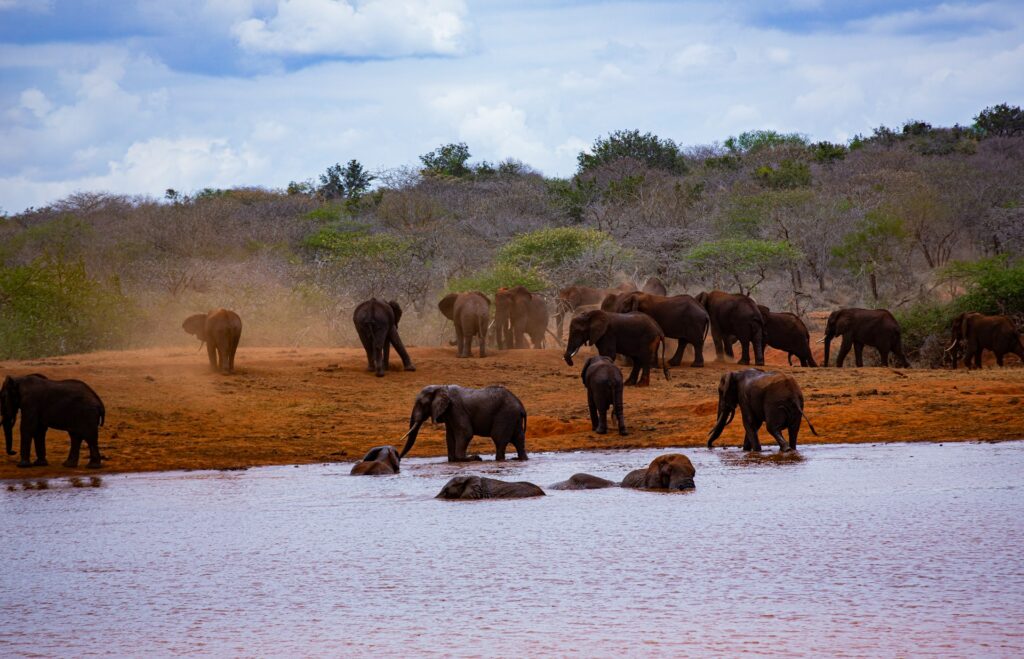
Tsavo’s elephants roll in the park’s iron-rich red soil, coating their grey skin in a deep ochre that can shade to almost terracotta in the right afternoon light. It is one of the most striking wildlife visual spectacles in Africa — a herd of large-bodied Tsavo elephants, red from trunk to flank, moving in a dusty column across pale savannah — and it exists nowhere else quite like this. Tsavo East hosts one of the largest elephant concentrations in Kenya, estimated at around 12,500 individuals, and the sight of these herds at the Galana River or around Aruba Dam makes a compelling case that Tsavo’s elephants, less photographed than Amboseli’s, are actually more extraordinary.
Key sites in Tsavo East:
Lugard Falls: On the Galana River, the river has carved through ancient rock into a series of twisted, polished formations that create narrow gorges, rapids, and deep pools. The visual is striking — smooth rock worn into impossible shapes by centuries of water pressure, with crocodiles resting on flat stones at the edge. Named after the British colonial official Frederick Lugard, who camped here in the 1890s, the falls are one of Tsavo East’s signature landmarks and require a brief walk from the vehicle to appreciate properly.
Aruba Dam: An artificial dam on the Voi River that has become one of the park’s most productive wildlife viewing spots — the permanent water drawing elephants, lions, giraffe, zebra, and hippos in the dry season concentrations that characterize Tsavo’s game viewing at its best. Late afternoon at Aruba Dam, with elephants arriving in family groups against the pink sky, is a scene that photographers come back for.
Mudanda Rock: A 1.6-kilometre whale-backed rock formation that acts as a water catchment for a natural dam below it. Hundreds of elephants are drawn to the water during the dry season, and the elevated rock surface allows you to look down on the gathering from an unusual perspective. It is also simply a beautiful geological feature — smooth, massive, and quietly imposing.
The Yatta Plateau: Running along Tsavo East’s western boundary for approximately 300 kilometers, the Yatta Plateau is the world’s longest lava flow — a remnant of a volcanic eruption estimated at over a million years ago. From the Galana River, the plateau rises as an escarpment, its basalt cap contrasting with the red soil below. It is less a dramatic spectacle than a statement of geological immensity — something that rewards contemplation over excitement.
Tsavo West: Volcanic, Dramatic, and Surprising
Tsavo West is smaller at approximately 9,065 square kilometers, but in many ways more cinematically beautiful. Where Tsavo East is horizontal and elemental, Tsavo West is vertical and varied — defined by volcanic hills, lava fields, crystal springs, and a landscape that shifts dramatically between ecological zones within short distances.
This is the park that travelers describe as “surprisingly beautiful” — which reveals the low expectations that precede a visit and the pleasantly overwhelming reality of the experience.
The Shetani Lava Flow: About 500 years ago, a volcanic eruption near the Chyulu Hills sent a stream of molten rock across the Tsavo West landscape, covering the land in black basalt that solidified into the formations still visible today. Shetani means “devil” in Swahili — the local communities who witnessed the eruption interpreted it as the surfacing of malevolent forces. You can walk the edge of the lava field, its surface broken and treacherous underfoot, black against the surrounding scrub, still looking freshly volcanic despite half a millennium of weathering. It is one of those landscapes that seems to belong to a different planet.
Mzima Springs: The crown jewel of Tsavo West, and one of the most extraordinary ecological phenomena in Kenya. Underground water filtrated through the porous lava rock of the Chyulu Hills emerges at Mzima as a series of crystal-clear springs that produce approximately 50 million gallons of fresh water daily. In the middle of one of Kenya’s driest landscapes, this is an almost incomprehensible volume of water bubbling up from the ground to create a river-like environment thick with vegetation.
The springs support hippos, crocodiles, and abundant fish, all visible in the clear water. But the extraordinary feature is the underwater observation chamber — a glass-walled chamber sunk into the spring pool that allows visitors to stand below the water surface and watch the hippos wading through the shallows above and around them. The hippos, bottom-lit by refracted sunlight, move through the water with a balletic quality that no land-based game drive ever reveals. Crocodiles hang motionless in the current. Barbel fish school in silver formations. It is, without qualification, one of the most unique wildlife experiences in Kenya.
The short trail through the forest at Mzima Springs also passes through acacia woodland that supports vervet monkeys and a remarkable variety of birds — including the palm-nut vulture, which feeds on palm fruits rather than carrion and is one of Africa’s more unusual raptors.
The Ngulia Rhino Sanctuary: One of the most important black rhino conservation sites in Kenya. The story of black rhinos in Tsavo is both devastating and redemptive — in the 1940s, an estimated 20,000 black rhinos roamed the park. By the late 1980s, intensive poaching had reduced that number to barely twenty individuals. The Ngulia Rhino Sanctuary — a 90-square-kilometre fenced enclosure within Tsavo West, managed with intensive anti-poaching protection — was established as a direct response to this collapse. Today, approximately 80 black rhinos live within the sanctuary, a recovery that represents decades of sustained effort and represents one of African conservation’s genuine success stories.
Guided rhino tracking drives operate within the sanctuary. Unlike the open-country rhino sightings at Nakuru or Ol Pejeta, the Ngulia experience tends to be more tracking-focused and more intimate — finding animals in bushier terrain with a guide who knows their territories and habits.
The Chyulu Hills: On Tsavo West’s northern border, the Chyulu Hills are a range of ancient volcanic cones covered in green grassland and forest — extraordinarily beautiful and accessible by hiking. The hills feel completely different from the lowland Tsavo environment, cooler and greener, and the views south across the Tsavo plain from the upper slopes are remarkable. The Chyulu Hills are also the aquifer that feeds Mzima Springs — the connection between these high, forested hills and the crystal water emerging 50 kilometers away is a satisfying example of landscape-scale ecological connectivity.
The Chaimu Crater: A short, relatively accessible hike up an extinct volcanic cone in the northwestern section of the park, rewarding with panoramic views of lava fields and the broader Tsavo landscape from a summit that takes about 45 minutes to reach.
The Maneless Lions of Tsavo: A Story That Refuses to Die
In 1898, two male lions became the most famous animals in Kenya — and quite possibly the most famous wild predators in human history at the time.
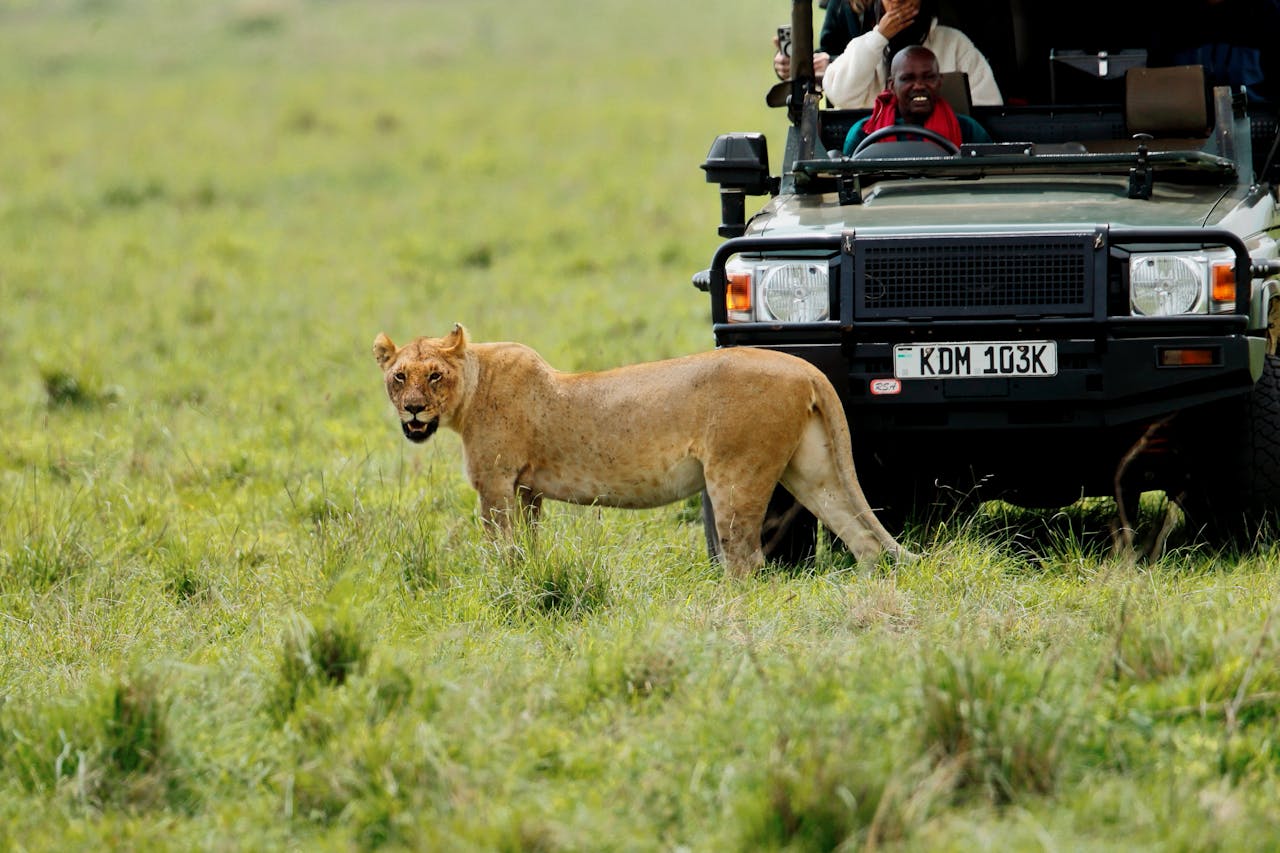
During the construction of the Uganda Railway, workers building a bridge over the Tsavo River were attacked repeatedly over nine months by a pair of male lions. The lions killed and consumed railway workers in their tents at night, with a frequency and apparent intelligence that paralyzed the work camp and eventually required the personal intervention of Lieutenant Colonel John Henry Patterson, who hunted them with remarkable difficulty before finally killing both animals. The death toll attributed to the lions at the time was 135 workers — a figure now disputed by researchers who place the number considerably lower, but still representing a genuinely extraordinary predatory campaign.
What made the Tsavo lions particularly distinctive — beyond their behavior — was their appearance: both were maneless, or nearly so. Virtually all adult male African lions develop manes, and a full, dark mane is traditionally associated with health, testosterone, and dominance. The Tsavo males had almost none.
The study of Tsavo’s lions has continued into the modern era, and the manelessness is now understood as likely an adaptation to the park’s specific conditions: the thick, thorny commiphora scrub through which Tsavo’s lions hunt would be impeded by a large mane, and the extreme heat of the lowland environment makes mane growth metabolically expensive. Tsavo’s lions are also physically larger on average than most savannah populations — longer-bodied, more powerfully built — and their hunting behavior tends toward persistence over speed, running prey to exhaustion in terrain where a large mane would be a liability.
The original Tsavo lion skins are preserved and displayed at the Field Museum in Chicago, where they remain one of the museum’s most visited exhibits more than 125 years after the animals were killed. In Tsavo, their descendants patrol the same terrain.
Wildlife: What to Expect on a Tsavo Safari
Tsavo’s wildlife is exceptional, and understanding the differences between the two parks helps you position yourself correctly.
In Tsavo East: The open savannah makes wildlife spotting relatively straightforward — visibility is high, and animal concentrations around the Galana River, Aruba Dam, and the various watering holes along the main game circuit are predictable in the dry season. Expect large elephant herds (the red elephant effect is at its most pronounced in Tsavo East), lion prides, cheetah on the open plains, giraffe, zebra, buffalo in large herds, gerenuk (the long-necked antelope of northern Kenya that appears here near the southeastern edge of its range), hippos and crocodiles at river points, and over 500 recorded bird species.
In Tsavo West: The denser vegetation means that game viewing requires more patience and more knowledgeable guiding — animals are present in excellent numbers but less immediately visible than on Tsavo East’s open plains. The reward is greater ecological variety: black rhino at Ngulia, hippos and crocodiles visible through the Mzima underwater chamber, elephants around the springs, leopards in the rocky hill country, and the extraordinary birdlife of the more vegetated habitat. Over 600 bird species are recorded across the combined Tsavo system.
The honest comparison with other parks: Tsavo does not deliver the same density of daily sightings as the Maasai Mara or Amboseli. Those parks are more intensively game-managed and have much higher concentrations of wildlife per square kilometer. Tsavo’s wildlife is spread across an enormous area, which means game drives require more time and more specialist guiding to maximize sightings. The trade-off is authenticity — the sense of wild Africa that exists in the Mara only partially, because the Mara is famous and Tsavo is not.
Tsavo as Part of a Larger Kenya Circuit
Tsavo’s position — between Nairobi and Mombasa, adjacent to Amboseli, and within reasonable distance of the north coast — makes it ideally suited to multi-destination itineraries.
The Southern Circuit: Nairobi → Amboseli (2 nights) → Tsavo West (2 nights) → Tsavo East (2 nights) → Mombasa or Watamu. This is one of the best three-to-four-week Kenya journeys available, combining the iconic Kilimanjaro elephants, Mzima Springs, the red elephants, and a beach finish on the north coast.
The Mombasa Extension: Tsavo East in particular is accessible from Mombasa — the park’s main gate at Bachuma is approximately 3 hours from Mombasa city center, making a Tsavo East addition a natural extension of any Mombasa or Diani coast trip.
By SGR train: The Madaraka Express Standard Gauge Railway from Nairobi to Mombasa passes through Tsavo East, and from the train windows, you can see wildlife on the open plains — including elephants, giraffe, and various antelope — making the train journey itself a preliminary taste of the safari.
Where to Stay in Tsavo
Voi Safari Lodge (Tsavo East) is the historic lodge — built in the 1960s at an elevated position overlooking a floodlit waterhole, with a swimming pool carved into the escarpment rock. Animals come to the waterhole at night, and the viewing from the lodge terrace is excellent. This is not a luxury property, but it has the bones and positioning of something genuinely special.
Kilaguni Serena Lodge (Tsavo West) is the premier address in the western park — the first lodge built in any Kenyan national park (1962), positioned with views of the Chyulu Hills and a floodlit waterhole visited by elephants and other wildlife at night. Comfortable, well-staffed, and with a history that gives it genuine character.
Ngulia Safari Lodge (Tsavo West) sits within the Ngulia Hills and offers excellent access to the rhino sanctuary. It is particularly famous among birders as a key site for night-trapping and ringing of Palearctic migrant birds during October and November — a specialist event that brings ornithologists from across the world.
Luxury options: The ecosystem around Tsavo West, particularly in and adjacent to the Chyulu Hills area, supports several excellent private camps — Ol Donyo Lodge (strictly speaking in the Chyulu Hills conservancy) and Campi ya Kanzi among them. These are among Kenya’s finest safari properties, combining the Tsavo landscape with the exclusivity of private conservancy access.
When to Go
June–October (Dry Season): The best window for game viewing. Vegetation is sparse, animals congregate at water sources, and the red elephants’ dust-bathing behaviour is at its most photogenic in the dry, heat-baked conditions. Temperatures are high (expect 30–38°C), so early morning and late afternoon game drives are essential.
January–March (Short Dry Season): Another good window. Cleaner conditions for Kilimanjaro views if combining with Amboseli, and solid game viewing across both parks.
April–May (Long Rains): Some roads in Tsavo East become impassable. The landscape becomes genuinely beautiful — green, dramatic, alive — but self-driving in heavy rains is inadvisable without local guidance. Prices drop and the parks are very quiet.
November–December (Short Rains): Migratory birds arrive, including extraordinary numbers of Palearctic migrants at Ngulia in October and November. Birding is exceptional. Game roads can be variable.
Getting There and Getting Around
From Nairobi by road: Tsavo West’s Mtito Andei gate is approximately 250 kilometers from Nairobi on the A109 Mombasa highway — roughly 3 hours. Tsavo East’s Voi gate is around 335 kilometers — approximately 4 hours. Both are well-signposted from the highway.
From Mombasa by road: Tsavo East’s Bachuma gate is approximately 170 kilometers from Mombasa — about 2.5 hours. Tsavo West’s Tsavo gate is further but accessible via the same highway.
By air: Charter flights operate from Wilson Airport in Nairobi to airstrips in both parks. This is the recommended approach for travelers combining Tsavo with Amboseli or the Maasai Mara, where the road distances become impractical.
4×4 essential: Tsavo East’s park roads, particularly near the Galana River and the Yatta Plateau, require a 4×4 vehicle. Tsavo West is more manageable but still benefits from proper ground clearance. Fuel up before entering — service stations within the parks are not guaranteed.
Birdwatching in Tsavo: Over 600 Species and a World-Famous Migration Spectacle
Tsavo’s reputation as a wildlife destination is built on its megafauna. But the birding case for Tsavo is, if anything, even stronger — and almost entirely unknown outside specialist ornithological circles.
The combined Tsavo system has recorded over 600 bird species, making it one of the richest avian habitats in Kenya. The diversity reflects the park’s ecological variety: open savannah species, riverine forest birds along the Galana, acacia woodland specialists, waterbirds at the dams and springs, and the extraordinary Ngulia ringing station.
The Ngulia Bird Ringing Station operates each October and November from Ngulia Safari Lodge, and it is a genuinely remarkable scientific and spectator event. Hundreds of thousands of Palearctic migrant birds — European robins, nightingales, thrushes, warblers, flycatchers, and dozens of other species — funnel through East Africa on their southbound migration, and the Ngulia Hills concentrate this movement in ways that the ringing station has been systematically documenting since the 1960s. In good conditions, thousands of birds can be caught, ringed, measured, and released in a single night. International ornithologists come specifically for this, and the lodge fills with birders during this period. For those who have never seen a bird ringing operation, the experience of holding a tiny European robin thousands of kilometers from its breeding territory is quietly extraordinary.
Beyond the migration spectacle, permanent highlights include: the martial eagle — Africa’s most powerful eagle, with a wingspan exceeding two meters, hunting from the thermals above Tsavo East’s open plains; the Somali ostrich in Tsavo East’s drier northeast (distinguished from Maasai ostrich by its blue-grey neck skin); the carmine bee-eater in spectacular colonies along the Galana River’s vertical banks; the Fischer’s lovebird in flocks that explode out of acacia thickets; and the Von der Decken’s hornbill, with its extraordinary red-and-yellow bill, one of the more improbable-looking birds in an ecosystem full of improbable-looking birds.
Conservation: What’s Happening in Tsavo Right Now
Tsavo’s conservation story is not a finished chapter — it is an active, ongoing narrative with setbacks and progress that any visitor should know about.
The Tsavo Trust is the primary conservation organization operating specifically in the Tsavo ecosystem, focusing on aerial monitoring of elephants (particularly large-tusked bulls vulnerable to poaching), anti-poaching operations, and human-wildlife conflict mitigation. Their aerial survey work has provided critical data on elephant population movements and has directly enabled rapid response to poaching incidents.
The elephant population across Tsavo has recovered significantly since the poaching catastrophe of the 1970s and 80s, when ivory hunters with automatic weapons reduced numbers to a fraction of historical levels. Today’s population is robust, but the large-tusked bulls that once defined Tsavo’s elephant heritage are still vulnerable — their ivory makes them disproportionately valuable to poachers, and their genes, which produce the park’s iconic great-tusked individuals in subsequent generations, are irreplaceable.
Water availability in a changing climate is Tsavo’s most significant emerging challenge. The park’s wildlife concentrates around permanent water sources — the Galana River, Mzima Springs, and the network of dams and waterholes maintained by Kenya Wildlife Service. As rainfall patterns become less predictable, the management of these water resources and the protection of the Chyulu Hills catchment that feeds Mzima are increasingly critical conservation priorities.
Visiting Tsavo and spending money there directly supports KWS’s management budget, the Tsavo Trust’s conservation operations, and the local community economies that exist in relationship to the park. It matters.
The Case for Tsavo Over More Famous Parks
The most compelling argument for Tsavo is not its specific attractions — extraordinary as they are. It is the experience of wilderness at genuine scale.
In the Mara, you will share popular sightings with multiple vehicles. In Tsavo East, your Land Cruiser at a waterhole at 7 AM may be the only vehicle in any direction. The silence between game drives is the silence of actual Africa, not a managed wildlife experience. The landscape is not spectacular in the way that Amboseli’s Kilimanjaro backdrop is spectacular. It is raw in a way that the more famous parks, with their greater tourist infrastructure, are not.
That rawness is exactly what a growing number of travelers are looking for — and the reason that Tsavo, for those who come understanding what it offers, consistently produces the most emphatic recommendations.
Tsavo rewards that kind of travel. It always has.
Ready to experience Kenya’s vast, raw wilderness? Enquire about Tsavo safari packages or request a southern Kenya circuit itinerary combining Tsavo with Amboseli and the coast.
Related Articles
Watamu Is Kenya’s Best Kept Coastal Secret and We Are Done Keeping It
There are coastal towns in Kenya that everyone knows about. Diani, with its global reputation and lo...
Samburu Is Not the Maasai Mara. It’s Wilder, Quieter, and Completely Addictive.
There is a type of traveler who has done the Maasai Mara. Maybe twice. They have the photographs of ...
Swept Away in Kenya: What Happens When You Finally Say Yes to Africa
There’s a moment — and every person who has ever set foot in Kenya will tell you this — where ...

What to Pack for Your Kenya Safari: Essential Tips for Every Traveler
Wondering what to pack for your Kenya safari? Smart packing is the key to a comfortable, safe, and m...